
Building a Way of Life Where Suicide Becomes Less Likely
Written/Narrated by: Ed Bejarana | Published on: May 3, 2026
A Position Paper from The Veterans Club
There is a quiet reality at the center of this issue that rarely gets said out loud, not because people don’t understand it, but because it’s difficult to quantify, difficult to present, and even more difficult to fund:
We cannot easily measure the lives that were never lost.
There is no report that tells us how many veterans or first responders chose to stay because someone remembered their name. No system that records the impact of a simple conversation over coffee that reminded a man or woman they still mattered. No dashboard that captures the moment someone decided to show up instead of withdrawing just a little bit further from the world around them.
And yet, that is where the real work happens.
For decades, the response to suicide among veterans and first responders has been built around intervention. We have invested in hotlines, clinical treatment, and emergency response systems designed to meet people in their darkest moments. These efforts are not misguided—they are essential, and they save lives. But they operate at the far end of the problem, at the point where isolation has already taken hold and a person is in crisis.
What they cannot do is rebuild the everyday human connections that quietly erode long before a crisis ever appears.
Because suicide, more often than not, does not begin in a single moment. It begins in the slow, almost unnoticeable drift away from others. It begins when the calls stop coming, when the invitations become less frequent, when a person no longer feels seen or known in any meaningful way. It begins when purpose fades, when identity becomes unclear, and when there is no longer a place where someone is expected to show up.
If that is where the problem begins, then it stands to reason that prevention cannot start in a crisis center. It must begin much earlier, woven into the ordinary patterns of life. Not as a program someone attends when something is wrong, but as a rhythm people return to week after week, whether life is going well or not.
This is the foundation of The Veterans Club. It is not built around intervention, but around environment. Around the belief that the most powerful form of prevention is not something we activate in a moment of emergency, but something we live inside of every day.
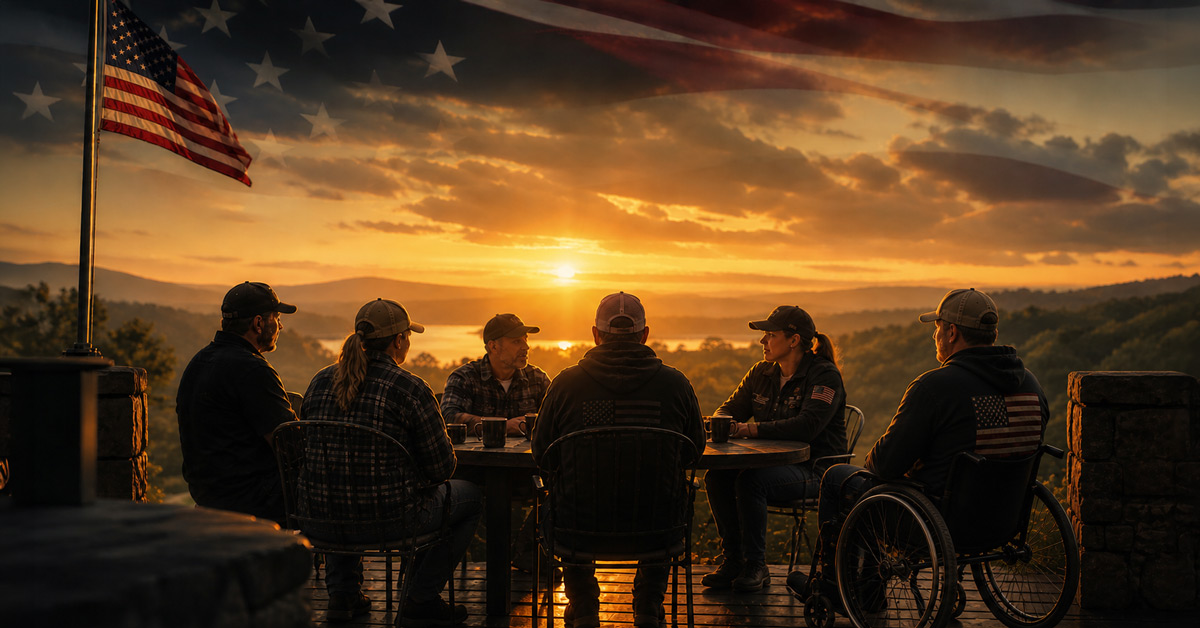
Across communities, small groups of veterans and first responders gather regularly. There is no elaborate structure, no expectation to share anything beyond what someone is comfortable with. They sit together, talk about life, tell stories, listen, and laugh. On the surface, it appears simple—almost too simple to be meaningful. But over time, something far more significant takes shape.
People begin to recognize one another. Names are remembered. Stories are carried forward from one week to the next. When someone misses a meeting, it is noticed. When life becomes difficult, there are familiar faces already in place, not strangers stepping in at the last moment. Trust is not forced—it is built slowly, through repetition, through presence, through the quiet consistency of showing up.
What emerges is not a program, but a form of social infrastructure. A network of relationships that makes it far less likely for someone to disappear into isolation without anyone realizing it. And that, in many ways, is the turning point.
Traditional approaches attempt to identify risk and respond to it. What we are describing is something different: reducing the conditions under which that risk is likely to develop in the first place. Not by eliminating hardship—because hardship is part of life—but by ensuring that no one carries it alone for very long.
When a person has a place where they are expected, when they are known by name, when they have relationships that have been built over time, and when there is a natural reason to show up again next week, the path toward isolation becomes more difficult to follow. It is not that pain disappears, but that it has somewhere to go. It has context. It has witnesses.
In that environment, the trajectory begins to shift, often in ways that are subtle and difficult to measure. Which is why the question of success must be reframed.
We may never be able to count the number of lives saved in the traditional sense. But we can observe something just as meaningful: participation. Engagement. The number of people who choose to step into community on a consistent basis.
If there are millions of veterans and first responders across the country, and only a fraction currently engage in any form of regular, community-based connection, then the opportunity is not simply to expand services, but to expand belonging. To make it normal, expected, and accessible for people to gather, not in response to crisis, but as part of everyday life.
Each additional person who sits down at a table with others, each conversation that unfolds naturally, each relationship that strengthens over time—these are not small, isolated events. They are incremental shifts in the broader landscape. Quiet adjustments to the odds.
What begins to take shape is not a program people consume, but a culture they participate in. A return, in many ways, to something that once existed more naturally—when people knew their neighbors, when checking in did not require a reason, and when community was not something scheduled, but something lived.
For veterans and first responders in particular, this matters in a very specific way. These are individuals who have been trained, often for years, to carry weight without complaint, to remain composed under pressure, and to manage situations that most people will never experience. That strength is real, and it is necessary. But over time, it can also become a form of isolation, not because they lack resilience, but because they lack a place where that weight can be set down without explanation.
What is needed is not another obligation, not another system to navigate, but a place where being present is enough. Where conversation can happen at its own pace. Where trust does not need to be negotiated because it has already been established over time.
This is what The Veterans Club is building—not a solution that activates in a moment of crisis, but a way of life that makes that crisis less likely to occur.
It would be easy to overlook the significance of something so simple. A group of people gathering over coffee does not, at first glance, appear to be a response to one of the most serious challenges facing this community. But simplicity, in this case, is not a weakness. It is the strength. Because it is sustainable. It is repeatable. And most importantly, it is human.
We cannot control every outcome, and we cannot reach every person in time. But we can shape the environment in which people live. We can make connection more accessible, more consistent, and more natural than isolation. We can create a world where it is harder to disappear unnoticed and easier to remain engaged, even during difficult seasons.
And in doing so, something begins to change.
Not in dramatic, easily measured spikes, but in quiet, steady ways.
Fewer people drift as far.
Fewer people carry as much alone.
Fewer people reach the point where intervention is the only option.
In that kind of world, suicide does not disappear entirely. But it becomes less likely—not because we fought it harder in the final moment, but because we made it harder for isolation to take hold in the first place.
That is the work.
And while we may never be able to point to every life that was saved, we can build something that, over time, ensures more people stay.

The Veterans Club is a Idaho Registered Nonprofit Corporate with 501(c)(3). Email info@theveteransclub.org if you are interested in getting involved or learning more about how you can support the effort.
Sponsors

Retirement Nationwide - Jim Lusk
Retirement Nationwide, led by Jim Lusk, provides ongoing support to The Veterans Club. Specializing in retirement and income planning, Retirement Nationwide helps individuals and families prepare for the future with confidence and clarity.

Rex Grace Insurance - Rex Grace
Rex Grace Insurance, led by Rex Grace, provides ongoing support to The Veterans Club. Through personalized insurance solutions, Rex Grace Insurance helps individuals, families, and businesses protect what matters most.

Zenith Exhibits, Inc. - Ed Bejarana
Zenith Exhibits, Inc. provides in-kind support to The Veterans Club through technology, website, and communications tools used every day. Zenith Exhibits helps organizations stay connected, organized, and working effectively.

Karen Reade - LifeWave
LifeWave and Karen Reade help underwrite select women’s gatherings at The Veterans Club. LifeWave focuses on wellness technologies that support healthy living. We are grateful for Karen’s generosity and commitment to stronger community connections.