
Connection Saves Lives: The Theory Behind Patriot Pour
Written by: Ed Bejarana | Published on: October 14, 2026
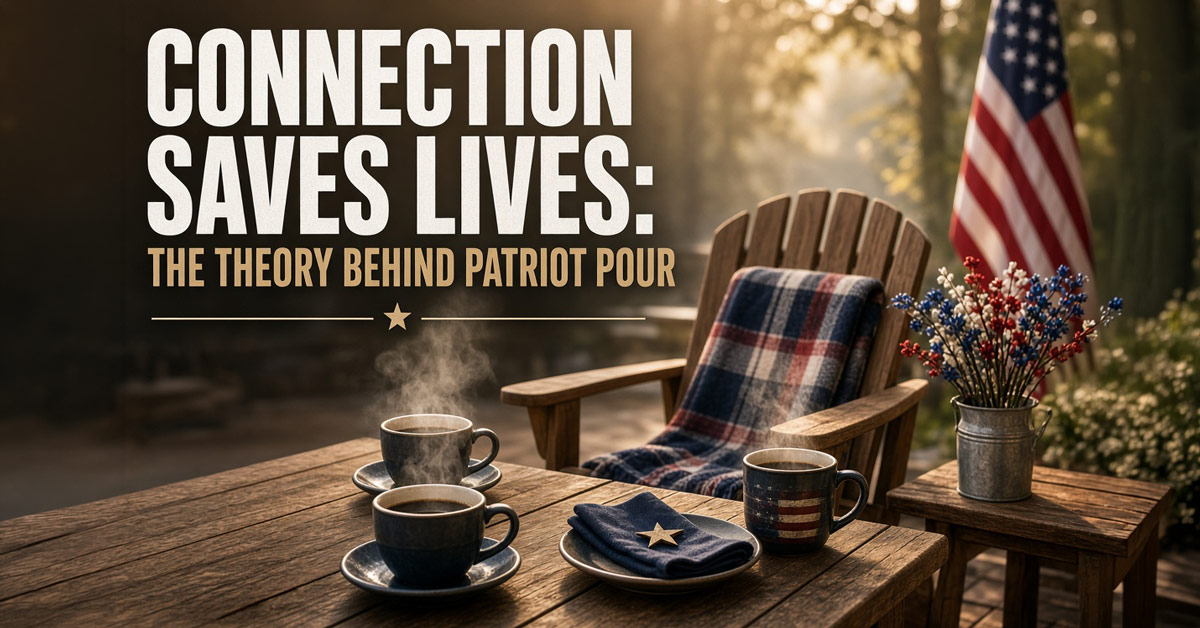
Patriot Pours have a rhythm of their own.
The first few people usually arrive before the room is ready for them, because that is what veterans and first responders tend to do. They come early. They find the same chairs. They pour coffee before anyone gives permission. They start with the safe subjects first—the weather, traffic, bad knees, the strange mystery of why every doctor suddenly looks twelve years old. Someone makes a joke about branch rivalry. Someone else gives a police officer a hard time about writing tickets. A firefighter tells a story that everyone knows is at least twenty percent improved from the last time he told it, but no one minds because the exaggeration is part of the entertainment.
At first glance, nothing about the room looks extraordinary. It is just coffee, conversation, and people who have lived enough life to enjoy a slow morning among familiar faces. There is no dramatic music playing in the background, no formal counseling session underway, no clipboard being passed around asking people to measure the condition of their soul. Most mornings, it looks wonderfully ordinary.
But ordinary is not the same thing as unimportant.
After a while, if you pay attention, you begin to see what is really happening. The newest person is not left standing awkwardly by the door. Someone waves him over, asks his name, and makes room at the table. The quiet woman near the end of the group listens for a while before finally adding something from her years in law enforcement, and when she speaks, the room turns toward her with respect. A retired Marine who looked uncomfortable during introductions begins laughing halfway through the meeting. A firefighter who has been carrying something heavy does not have to explain every detail, because enough people in the room already understand the shape of it.
Then someone notices an empty chair.
“Anybody heard from Mike?”
The question is usually asked casually, almost in passing, but I have come to believe it may be one of the most important sentences spoken at any Patriot Pour gathering. Mike is normally early. He sits in the same general area, drinks the same coffee, and complains about the same things with the dependable precision of a man who has earned the right to have opinions. No one panics when he is not there. No one turns the moment into a production. But somebody reaches for a phone. Somebody says they will text him. Somebody else remembers he had an appointment last week. Another person says they can swing by later if no one hears back.
No one announces that suicide prevention is taking place. No one uses clinical language. No one says, “We are now engaging in protective intervention through peer-based relational accountability.” That would ruin the whole thing anyway. What happens is much simpler and, in many ways, much more powerful.
Someone noticed.
That is the heart of Patriot Pour.
At The Veterans Club, we often say Connection Saves Lives, and while it is a simple phrase, it is not a decorative slogan. It is the working theory behind everything we are trying to build. The idea is not that coffee cures despair, or that a weekly meeting replaces professional care, or that veterans and first responders can simply laugh their way through every hard season of life. We know better than that. Many people need counselors, doctors, chaplains, crisis support, medication, treatment, or all of the above at different points in their lives, and there should be no shame in any of it.
But we also know this: human beings were not designed to carry life alone. For veterans and first responders especially, the loss of meaningful connection can become dangerous long before anyone calls it a crisis. Patriot Pour exists in that space before the emergency, where isolation begins to loosen its grip because people are once again known, expected, and missed when they are gone.
Most people who have served in the military, law enforcement, fire service, emergency medical services, or similar professions understand a kind of belonging that is hard to explain to outsiders. It is not always soft or sentimental. In fact, it is often wrapped in sarcasm, dark humor, shared complaints, and the kind of teasing that would sound rude if it came from anyone else. But underneath all of that is something deeply human. There is a team. There is a mission. There is structure. There are people who know where you are supposed to be and notice when you are not there.
In uniformed service, belonging is often built into the day whether anyone talks about it or not. You know who you work with. You know who you trust. You know who talks too much, who keeps calm under pressure, who makes terrible coffee, who can be counted on when things get ugly, and who needs checking on after a hard call. You may not describe it as community while you are living inside it, but that is exactly what it is. It is a social operating system built out of shared responsibility.
Then life changes.
Sometimes the change comes through retirement. Sometimes it comes through injury, relocation, divorce, grief, promotion, burnout, or the slow reshuffling that happens as years pass and people move in different directions. Even those still actively serving can find themselves disconnected from the kind of peer relationships that once helped them stay grounded. A new assignment can change everything. A department culture can shift. A unit can break apart. A person can be surrounded by people all day and still feel profoundly alone.
Isolation rarely arrives as a dramatic event. It is usually much quieter than that. One missed lunch becomes two. A phone call goes unanswered. The people who once checked in regularly assume someone else is doing it. A person who spent years living in a world of teams and shared purpose suddenly has long stretches of time where no one is expecting them anywhere. That kind of silence can become heavy, especially for people who spent their lives trained to be useful, dependable, and needed.
This is one reason Patriot Pour is intentionally simple. We are not trying to impress anyone with complexity. Complexity often keeps people away. A man may not be ready to sign up for a program, admit he is struggling, or sit in a circle and talk about feelings. A retired officer may not want to be treated like a project. A firefighter may not want another person handing him a brochure. But most people can accept an invitation to coffee.
Coffee lowers the drawbridge.
It gives people a reason to walk into the room without having to explain why they came. They can tell themselves they are just stopping by. They can sit near the edge and listen. They can leave early if it feels awkward. They can come back the next week and still not say much. There is dignity in that. Patriot Pour does not demand instant vulnerability, which is exactly why vulnerability eventually becomes possible.
Trust grows slowly in ordinary rooms.
A new person may walk in stiff, guarded, and unsure whether this gathering is for them. The first week, they mostly observe. The second week, someone remembers their name. The third week, someone asks a follow-up question from something they mentioned before. Over time, the room becomes less foreign. The faces become familiar. The jokes start making sense. The person who once sat near the edge begins leaning in. Eventually, they are no longer “the new guy” or “the new lady.” They are simply part of the table.
That movement from stranger to regular to friend is not accidental. It is the quiet architecture of belonging.
The danger of isolation is that it teaches a person a false story. It says, “Nobody notices.” It says, “Nobody understands.” It says, “You are no longer useful.” It says, “If you disappeared, life would go on just fine without you.” Those thoughts do not always announce themselves loudly, but they can become powerful when a person sits alone with them long enough.
Relationship tells a different story.
Relationship says, “We saved you a seat.” Relationship says, “You were missed.” Relationship says, “You still have something to offer.” Relationship says, “Your story is not too strange for this room.” Relationship says, “You are not done yet.”
That is where peer-to-peer connection becomes so important. Veterans and first responders often carry experiences that are difficult to translate. They may not want sympathy, and they may not trust easy answers. What they often respond to is the presence of someone who has lived close enough to the same kind of world to understand without needing every detail explained. That kind of understanding does not fix everything, but it reduces the exhausting burden of translation.
There is relief in being with people who already understand the language.
A veteran can mention a deployment, a transition, a hard return home, or the strange discomfort of civilian small talk, and someone at the table nods before the sentence is finished. A retired officer can talk about missing the work without missing all of it, and the room understands the contradiction. A firefighter can joke about the old station days and then grow quiet for a moment, and nobody rushes to fill the silence. In healthy peer rooms, silence is not always awkward. Sometimes it is respect.
This is also why Patriot Pour is not a free-for-all conversation thrown together under the assumption that good things will automatically happen if enough people drink coffee in the same room. The culture of the room matters. In fact, it may matter more than the coffee, the location, or the agenda. A gathering can either pull people toward life or let them sink deeper into cynicism. The difference is often leadership.
A facilitator does not need to control every sentence, but someone must care about the direction of the room. Without that care, even well-meaning groups can drift. One person dominates every conversation. Another turns each meeting into a complaint session. Old cliques form. New people feel invisible. Dark stories pile on top of dark stories until the room feels heavier when people leave than when they arrived. That is not connection. That is shared isolation wearing the costume of community.
A good Patriot Pour facilitator understands something subtle: the mission is relationship, and conversation is the vehicle. The facilitator protects the tone without making the room artificial. Hard subjects are not pushed away. Pain is not treated as an inconvenience. Grief, frustration, anger, loss, and disappointment all have a place at the table because real life has a place at the table. But the room cannot be allowed to become a pit. Someone has to help the conversation breathe.
That may mean inviting a quieter member into the discussion. It may mean gently redirecting when politics or bitterness begins taking over. It may mean letting a difficult story land and then allowing humor to return without apology. Veterans and first responders understand that balance better than most. They know how laughter and sorrow can sit inches apart. They know that a good joke after a hard story is not disrespect. Sometimes it is how people survive.
The best Patriot Pour meetings do not feel managed. They feel healthy. That is the art.
Over time, the weekly rhythm begins doing work no single meeting could accomplish. A person who might avoid a formal support group keeps showing up because nobody is asking him to become a case study. A spouse begins noticing that Thursday mornings change the rest of the week. A man who had been withdrawing starts making plans again. A woman who was hesitant at first brings another retired officer with her because she knows the room is safe enough. Someone who came only for coffee begins helping organize a dinner, then a service project, then eventually becomes one of the people others look for when they arrive.
This is where the three pillars of The Veterans Club begin to appear naturally, not as theory on paper but as lived experience. Connection starts with the weekly gathering, the handshake, the familiar table, the ordinary rhythm of being together. Purpose returns when members begin serving again, even in small ways, because usefulness is part of human dignity. Belonging takes root when someone stops attending as a guest and begins carrying responsibility for the health of the community itself.
The movement is gradual, but it is powerful.
I think often about the person who first walks into Patriot Pour uncertain whether they belong. Maybe they were invited by a friend. Maybe they saw something online. Maybe a spouse pushed them to go because she knew he needed people even if he would never say it out loud. Whatever brought them through the door, the first visit is usually fragile. A cold room, an awkward welcome, or a clique that does not make space could send them away for good.
But when the room works the way it should, something else happens. They are greeted warmly but not smothered. They are invited in but not interrogated. They hear laughter that does not feel forced. They see people from different branches, agencies, eras, and backgrounds sitting together without needing to compete over who had it harder. They discover that the gathering is neither therapy nor a sales pitch nor a political argument. It is simply a room full of people who understand the value of not being alone.
That kind of room can change a person’s week.
Enough weeks can begin to change a life.
There is nothing flashy about this theory, which may be why it is easy to underestimate. We live in a world that likes programs, campaigns, slogans, metrics, and grand strategies. Those things have their place. But much of what protects a life happens at a smaller scale. It happens when someone gets a text after missing coffee. It happens when a member is invited to dinner instead of left at home. It happens when a retired first responder realizes there are still people who want to hear his stories. It happens when someone who has been isolated for months begins planning around a weekly meeting because the table has become part of his life.
The power of Patriot Pour is not found in any single moment. It is found in accumulation.
One cup of coffee may not change much. One conversation may not turn a life around. One handshake may not interrupt despair. But week after week, those small moments gather weight. Familiarity becomes trust. Trust becomes honesty. Honesty becomes friendship. Friendship becomes accountability. Accountability becomes protection.
And protection, in this context, does not mean surveillance or pressure. It means people are close enough to notice changes. Close enough to hear the difference between ordinary tired and something heavier. Close enough to say, “You don’t seem like yourself today.” Close enough to follow up after the meeting. Close enough to care without making a spectacle of caring.
That is one of the reasons the empty chair matters so much. The chair is not just furniture. It is evidence that someone has become part of the room. Their absence has meaning because their presence has meaning. When someone is missed, they are reminded that their life is connected to other lives.
This may be the most important truth Patriot Pour teaches: belonging is not built by announcing that everyone belongs. Belonging is built when people experience being known.
You can tell a veteran he matters, and he may or may not believe you. You can tell a retired officer she is welcome, and she may politely nod while keeping her guard up. But when someone remembers their name, follows up on their story, saves them a seat, asks where they were last week, invites them to the next dinner, and trusts them enough to help welcome the next newcomer, the message becomes harder to dismiss.
Belonging becomes real because it is practiced.
That is why relationship is not a soft idea. It is infrastructure. For The Veterans Club, relationship is the bridge between isolation and hope. It is the environment in which purpose can return. It is the condition that makes service possible again. It is the reason someone who had been drifting begins to reattach to life.
Suicide ideation does not always disappear because someone suddenly becomes happy. Often, the first movement away from despair is much more modest. A person begins to feel less alone. They begin to believe tomorrow contains at least one familiar face. They begin to remember that someone expects them. They begin to rediscover that they are not merely surviving as an individual but living as part of a community.
That is why Patriot Pour matters.
Not because coffee is magic.
Not because every meeting is profound.
Not because every conversation is deep.
Most conversations are not deep at all. They are about trucks, grandkids, bad backs, military stories, old calls, fishing, football, breakfast, and the ridiculous price of everything. But underneath those ordinary conversations, something sacred is being rebuilt. People are learning to trust the room. They are learning to show up. They are learning to be missed. They are learning, sometimes reluctantly, that they still belong to something.
There is a sentence I keep returning to because it captures the heart of the whole thing:
There is a place where people like you gather every week, and someone will notice if you’re missing.
That is Patriot Pour in its simplest form.
It is not complicated, but it is not small.
In a world where too many veterans and first responders quietly disappear into isolation, a familiar table can become a lifeline. A weekly routine can become an anchor. A room full of peers can become a place where despair has to compete with laughter, memory, responsibility, and friendship.
Connection saves lives because connection gives life something to hold onto.
And sometimes, the work of saving a life begins with the most ordinary sentence in the world:
“Anybody heard from Mike?”
The Veterans Club is a Idaho Registered Nonprofit Corporate with 501(c)(3). Email info@theveteransclub.org if you are interested in getting involved or learning more about how you can support the effort.


Sponsors

Retirement Nationwide - Jim Lusk
Retirement Nationwide, led by Jim Lusk, provides ongoing support to The Veterans Club. Specializing in retirement and income planning, Retirement Nationwide helps individuals and families prepare for the future with confidence and clarity.

Rex Grace Insurance - Rex Grace
Rex Grace Insurance, led by Rex Grace, provides ongoing support to The Veterans Club. Through personalized insurance solutions, Rex Grace Insurance helps individuals, families, and businesses protect what matters most.

Zenith Exhibits, Inc. - Ed Bejarana
Zenith Exhibits, Inc. provides in-kind support to The Veterans Club through technology, website, and communications tools used every day. Zenith Exhibits helps organizations stay connected, organized, and working effectively.

Karen Reade - LifeWave
LifeWave and Karen Reade help underwrite select women’s gatherings at The Veterans Club. LifeWave focuses on wellness technologies that support healthy living. We are grateful for Karen’s generosity and commitment to stronger community connections.