
Putting On the Glasses Changed What I Thought I Knew About Blindness
Written by: Ed Bejarana | Published on: October 17, 2026
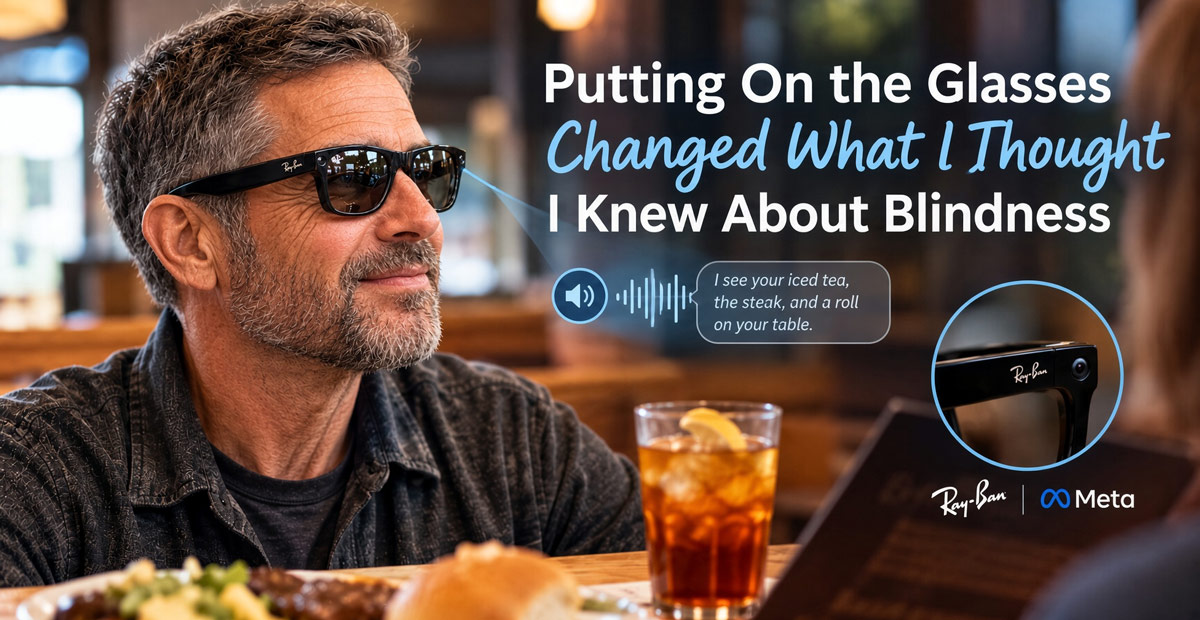
I sat across from Evan Bodle at Texas Roadhouse and watched him carry on a normal conversation while the server came and went. Nothing about the way he moved or engaged suggested he was blind. The Ray-Ban frames he was wearing looked like ordinary glasses. Only later did I realize those frames were doing the work of describing the room, the table, and the menu for him.
Evan offered to let me try them. I put them on and asked, simply, what I was looking at. A voice answered through the open-ear speakers in the temples—clear, close, and private, as if someone were speaking quietly near my head rather than announcing to the table. It described the lunch setting in detail: the colors of the iced tea, the food on the plates, the choices and arrangement a sighted person would absorb without thinking. The accuracy was immediate and specific.
Next I asked it to identify the person sitting directly in front of me. It declined facial recognition for privacy reasons, yet still described Evan with striking precision—the colors and style of his clothing, the details that matched what I could see. Then I asked about the appetizers. It read the Texas Roadhouse menu list back to me, item by item.
The glasses are a collaboration between Ray-Ban and Meta. They contain a camera, microphones, and Meta AI. You wake them with “Hey Meta.” For someone who is blind or has low vision, the practical result is a hands-free way to receive descriptions of surroundings, identify objects, and hear text read aloud. An accessibility option called Detailed Responses gives richer accounts of scenes. The same glasses can also connect to Be My Eyes by saying “Hey Meta, Be My Eyes.” That service links the wearer to a global network of sighted volunteers who see the camera feed and offer real-time help. Be My Eyes is free to download and use for people who are blind or have low vision—no subscription, no per-call charge, and no usage limit. Volunteers donate their time, and the service stays free for individual users through business partnerships. The open-ear speakers keep the exchange discreet while still allowing ambient sound.
These are not medical devices and do not replace a cane, guide dog, or mobility training. What they do provide, at a retail price that typically ranges from roughly $300 to $450 depending on generation and style, is a stylish, everyday tool for ordinary tasks that sighted people take for granted.
Evan also told me about the audio description services available for live theater and movies. Trained describers or pre-scripted tracks fill in the visual gaps—costumes, gestures, set changes, action that happens between lines of dialogue—so a person without sight can follow the full story. Those services open the door to performances that would otherwise remain partially closed. The glasses, in a different way, open the ordinary world: the color of a drink, the layout of a table, the clothing of the person across from you, the text on a menu. Together they begin to answer a larger question: how much of a sighted world can become accessible when description is available both for the stage and for the everyday moments in between.
Evan received his pair through the VA because of his service-related situation. Separately, Meta has launched a national effort to provide free Ray-Ban Meta glasses to every legally blind U.S. veteran—more than 130,000 people are eligible—through a partnership with the Blinded Veterans Association. Qualifying veterans can request them at bva.org/glasses, and training resources come with the program.
Sitting there with the glasses on, hearing the menu and the table described accurately and privately, I kept thinking about our own community. The Veterans Club exists to strengthen connection and reduce isolation. Some of our members, and some of their family members, live with significant vision loss. A program that helped them obtain Meta glasses—whether through fundraising, sponsorship, or partnership—would put a practical tool in their hands for the everyday moments that still matter: reading a menu, confirming what is on the table, or simply knowing the details of the room around them. It would not replace the description services Evan already uses for theater and film, or the free Be My Eyes volunteer network, but it could widen the rest of the day.
If you or someone in your family lives with vision loss, or if you want to help make these glasses more accessible to members of The Veterans Club, reach out. Let’s figure out what a program could look like—fundraising, sponsorships, partnerships, or simply spreading the word about the free options already available. The technology is real. The need is real. The question is whether we’re willing to do something about it.
The Veterans Club is a Idaho Registered Nonprofit Corporate with 501(c)(3). Email info@theveteransclub.org if you are interested in getting involved or learning more about how you can support the effort.


Sponsors

Retirement Nationwide - Jim Lusk
Retirement Nationwide, led by Jim Lusk, provides ongoing support to The Veterans Club. Specializing in retirement and income planning, Retirement Nationwide helps individuals and families prepare for the future with confidence and clarity.
Rex Grace Insurance - Rex Grace
Rex Grace Insurance, led by Rex Grace, provides ongoing support to The Veterans Club. Through personalized insurance solutions, Rex Grace Insurance helps individuals, families, and businesses protect what matters most.
Zenith Exhibits, Inc. - Ed Bejarana
Zenith Exhibits, Inc. provides in-kind support to The Veterans Club through technology, website, and communications tools used every day. Zenith Exhibits helps organizations stay connected, organized, and working effectively.

Karen Reade - LifeWave
LifeWave and Karen Reade help underwrite select women’s gatherings at The Veterans Club. LifeWave focuses on wellness technologies that support healthy living. We are grateful for Karen’s generosity and commitment to stronger community connections.